26× Faster: Rewriting the Codebase Grapher in Rust
The Python prototype of graphify was reliable — 429 auto-rotation and provider failover meant it kept working under real rate limits (part 1). But it was slow, and it shipped a whole environment.
The numbers that decided the rewrite:
- 420 ms to extract a benchmark repo of 110 source files / 422 edges — in Python
- 16 ms for the same extraction — in Rust
- 26.25× faster, measured on the same machine in the repo's own benchmark
Why Rust won
Rayon parallelism, not threads by hand. Source files are independent until the graph is linked, so extraction parallelizes across cores with Rayon and gets a near-linear speedup. The Python version was single-threaded — that alone was most of the gap.
petgraph with arena pre-allocation. Node and edge storage is a flat arena allocated up front for the expected size, so graph construction avoids per-node allocation churn. The graph structure is the product; making it cheap to build is the whole game.
A binary, not an environment. The Python version needed a multi-GB interpreter + dependency stack on every machine that ran it. The Rust release build is a single static binary you drop anywhere — which is what made a CLI and TUI practical.
The TUI was a side effect of going native
Once the core was a fast library, the interactive front-end stopped being a web app question and became a terminal question:
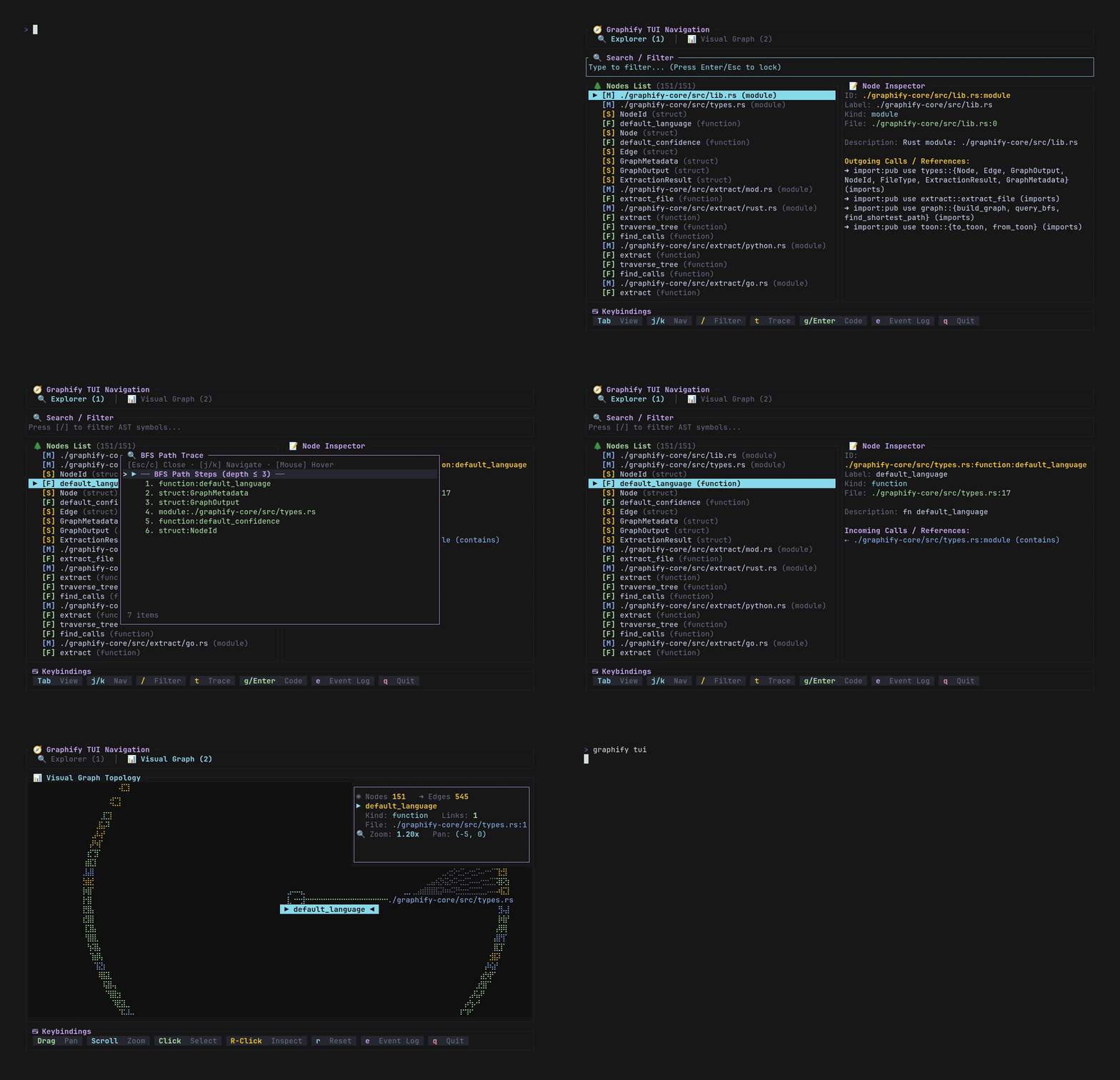
Because extraction takes milliseconds, the TUI can re-extract live and re-render the graph as you navigate — something an HTTP round-trip to a Python service could never feel like.
Tokens are the real currency
For AI assistants, the output format matters as much as speed. The Rust version emits a compact columnar .toon (Token-Oriented Object Notation) text format instead of JSON — 74 KB vs 185 KB for the same graph (−60% tokens).
Two phases in, the tool is reliable and fast. Part 3: it extracts its own codebase — and the numbers are real.